
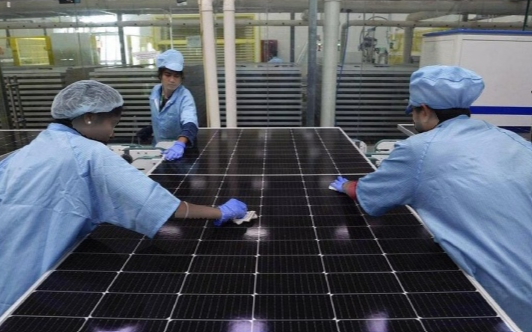
India’s ambitious drive to become a global leader in solar manufacturing is facing significant challenges, with several newly built factories operating below capacity due to continued dependence on imported components from China. While government initiatives such as the Production Linked Incentive (PLI) Scheme and domestic manufacturing targets have encouraged investment in solar module and cell production, manufacturers still rely heavily on China for critical raw materials, including polysilicon, wafers and advanced solar cells. This dependence has limited the growth of a fully integrated domestic supply chain, leaving many production facilities underutilized despite rapidly increasing demand for renewable energy.
India has set a target of installing 500 gigawatts (GW) of non-fossil fuel electricity capacity by 2030, with solar energy expected to play a central role in achieving that goal. However, industry experts warn that reducing reliance on imported inputs will require sustained investment in upstream manufacturing, technology development and skilled workforce expansion. Strengthening domestic production of essential solar materials, improving supply chain resilience and encouraging innovation could help India secure its clean energy transition while reducing exposure to global trade disruptions. The challenge underscores that building renewable energy capacity is not only about installing solar panels but also about creating a resilient and self-reliant manufacturing ecosystem. More