
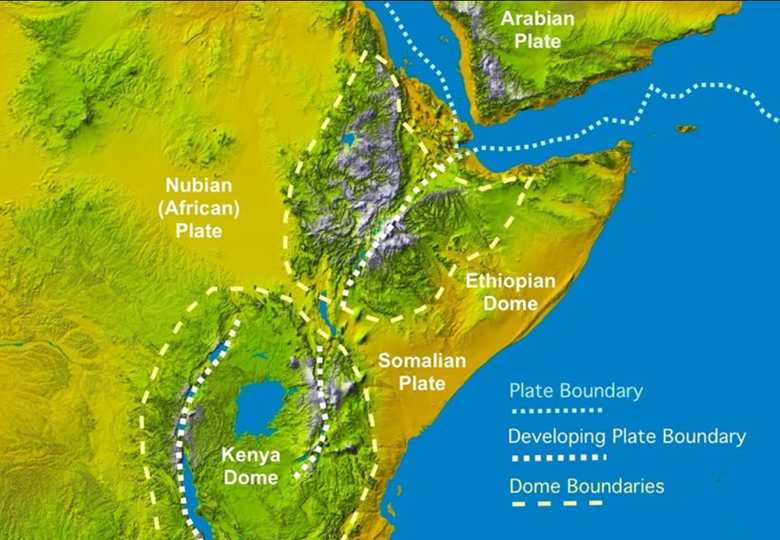
A major geological event is taking place beneath East Africa, as the continent is slowly splitting apart. This process is occurring along the East African Rift, a massive tectonic boundary that stretches from the Red Sea all the way down to Mozambique. The rift is caused by the movement of two tectonic plates, the Somali and Nubian plates, which are slowly pulling away from each other. As the plates drift, magma from beneath the Earth’s surface causes the crust to stretch and crack, resulting in increased volcanic and seismic activity in the region. Scientists estimate that this rifting could lead to the formation of a new ocean basin over the next one to ten million years.
The focus of this process is the Afar Triangle, where the rift is most active, and where areas of the Earth’s crust are already thinning and sinking. In fact, a significant rifting event occurred in 2005 when a large 35-mile-long crack opened up in the region. If the rift continues to widen, the Indian Ocean could eventually flood the area, separating the Horn of Africa from the rest of the continent and creating a new ocean. This dramatic change could have significant environmental and climatic impacts, altering local ecosystems, weather patterns, and even global ocean currents. Though this transformation is still millions of years away, it serves as a powerful reminder of how Earth’s geological processes are constantly reshaping the planet. More