
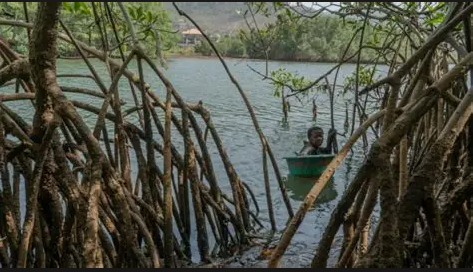
Along the coastline around Freetown, Sierra Leone, mangroves are disappearing—and with them, an important source of food and income for communities that have depended on oyster harvesting for generations. For many women, collecting oysters is not just a traditional activity but a way to support their families and pay for everyday needs. Millicent Turay, who has harvested oysters for around 20 years, can earn about US$7 on a good day, working in muddy mangrove waters during low tide to collect oysters attached to roots and rocks. But she says the harvest is declining as more mangroves are cut down. Across Sierra Leone, more than 25% of mangrove cover has disappeared since 1990, with urban expansion, firewood collection, illegal construction and land reclamation putting increasing pressure on these coastal forests. In the Aberdeen coastal area near Freetown, mangrove cover fell from 537 hectares in 2017 to 458 hectares by February 2025, showing how quickly this ecosystem is being lost.
The problem goes much deeper than the loss of oysters. Mangroves provide breeding and feeding grounds for fish and other marine life while helping protect coastal communities from erosion, flooding and the growing impacts of climate change. At the same time, traditional oyster harvesting can also damage the ecosystem when mangrove branches and roots are repeatedly cut to reach oysters, creating a difficult cycle where people depend on the forest while their livelihood can unintentionally contribute to its decline. Some communities are now trying a different path. In Kolleh Town, the organisation Nature for Mangroves is working with residents to develop oyster farms using bamboo structures, ropes, oyster shells and coconut husks, while also cultivating oyster larvae. The idea is to give oysters a place to grow without putting the same pressure on wild mangroves. Sierra Leone’s experience shows a much bigger lesson for coastal communities everywhere: protecting mangroves is not only about saving trees—it is about protecting food, women’s livelihoods, biodiversity, coastal defence and the future of communities living at the water’s edge. More