
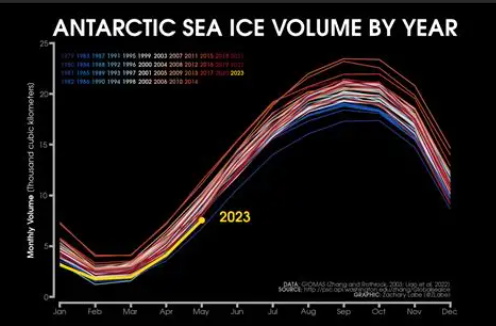
New research provides a clearer mechanism for the unusual behaviour of sea ice around Antarctica, which expanded slowly for several decades before declining sharply after the mid-2010s. Scientists found that from the 1970s to around 2015, increased precipitation and snowfall freshened the surface of the Southern Ocean. This created a low-salinity surface layer that reduced ocean mixing, effectively insulating the ice from warmer, deeper waters. During this period, Antarctic sea ice extent reached record highs in some years, despite a long-term warming trend in the global climate system.
The study also identifies why the system shifted so quickly after about 2015–2016. Stronger wind patterns—linked in part to natural variability and changes in atmospheric circulation—helped break down the stable surface layer, increasing vertical mixing in the ocean. This allowed subsurface heat, stored in the upper Southern Ocean, to rise and accelerate basal melting of sea ice. Satellite observations show that Antarctic sea ice then dropped to record low levels in the early 2020s, with losses exceeding 1 million square kilometres below the long-term average in some years. Scientists warn that this transition could indicate a “regime shift,” where Antarctic sea ice becomes more variable, thinner, and more sensitive to ocean heat, amplifying feedbacks between warming oceans and polar ice loss. More