
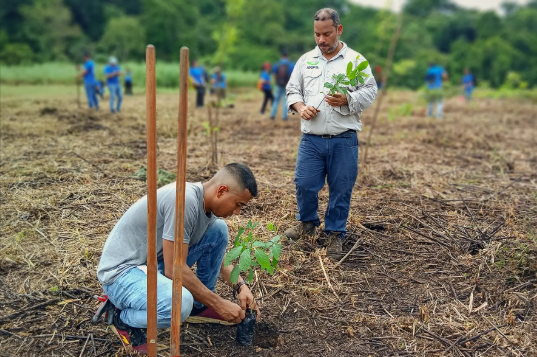
In the heart of Panama’s Ngäbe-Buglé Comarca, Indigenous communities are leading a groundbreaking reforestation initiative that merges ancestral land knowledge with cutting-edge ecological science. This community-driven project—backed by the Smithsonian Tropical Research Institute and aligned with data from the Agua Salud reforestation experiment—is restoring over 100 hectares of degraded land using native tree species. Unlike many carbon offset schemes, this program ensures that local farmers maintain full ownership of their land and the trees they plant, empowering them to lead both environmental and economic restoration. Farmers are compensated annually with around $130 per hectare for up to 20 years through verified carbon credit systems, eliminating the need to cut trees for income and promoting long-term forest health.
Beyond carbon sequestration, this reforestation effort is revitalizing biodiversity, securing watersheds, and offering a replicable model for inclusive climate solutions. The project emphasizes participatory governance, where community members are trained in forest monitoring, ecological restoration, and sustainable land management. By combining traditional stewardship with scientific insight, this initiative not only meets Panama’s climate goals but also strengthens cultural identity and local resilience. It’s a powerful demonstration that the future of global reforestation may lie in Indigenous leadership—where conservation and community well-being grow together. More