
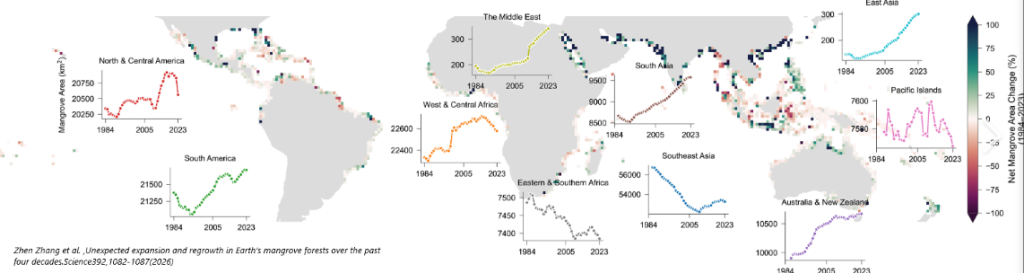
A new study has revealed an encouraging turnaround for the world’s mangrove forests after decades of destruction and degradation. Researchers from Tulane University analysed annual Landsat satellite images from 1984 to 2023, creating a 30-metre-resolution record of global mangrove changes. The findings show that mangrove losses began to be offset by natural expansion around 2010, leaving a cumulative global decline of only about 1% since the 1980s. Even more significantly, the share of denser, closed-canopy mangrove forests increased from around 50% in the 1980s to 58% in 2023. Much of the recent recovery has occurred through natural regeneration, with mangroves colonising newly formed coastal mudflats and abandoned aquaculture areas.
The recovery offers a rare piece of good environmental news, but scientists caution that it is not a reason to slow conservation efforts. Mangroves are vital coastal ecosystems that store large amounts of carbon, provide breeding grounds for fish and help protect communities from coastal erosion, storms and flooding. Restoration projects, stronger legal protection and reduced deforestation have contributed to the positive trend, while natural regeneration has played an important role. However, recovery remains uneven: Southeast Asia has moved toward growth, while parts of West and Central Africa continue to experience serious losses, particularly in areas affected by oil pollution and land-use pressures. Rising sea levels, extreme weather and continued coastal development also threaten future gains. The study therefore delivers an important message: when human pressure is reduced, nature can recover but protecting these gains requires continued action against deforestation and climate change. More