
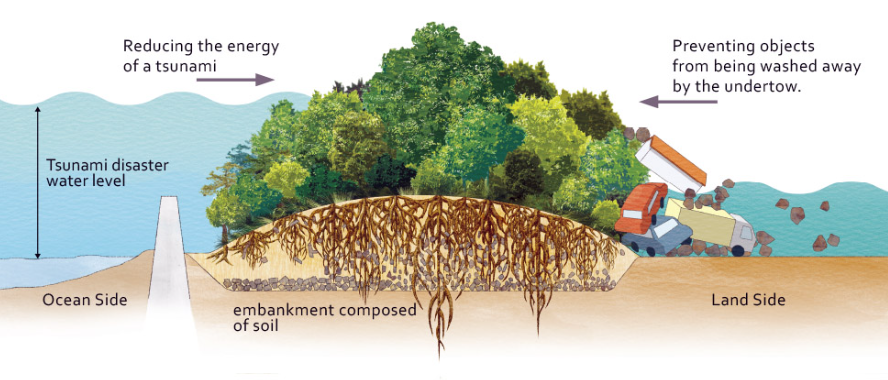
Along Japan’s tsunami-prone northeastern coast, communities are turning to trees as another line of defence against future disasters. The Chinju no Mori Project has planted around 680,000 trees over the past 14 years, including more than 12,000 trees planted by over 1,000 volunteers in Minamisoma, Fukushima, in June 2026. The idea comes from Japan’s traditional “guardian forests” around Shinto shrines, many of which survived the devastating 2011 earthquake and tsunami. That disaster followed a magnitude 9 earthquake and produced waves that reached around 40 metres in some places, killing more than 19,700 people and devastating roughly 2,000 kilometres of northeastern coastline. Instead of relying only on concrete, the project is creating dense coastal forests using a mixture of native trees, shrubs and plants inspired by the Miyawaki method.
The trees are not being presented as a replacement for seawalls, but as part of a multi-layered defence system. Research looking at major tsunamis in 1896, 1933, 1960 and 2011 found that coastal forests could help reduce deaths and destruction, particularly by slowing tsunami flows and trapping floating debris. In some places, forests also encouraged communities to keep homes away from the most exposed coastal areas. Japan has spent about 1.4 trillion yen (around US$8.2 billion) building 432 kilometres of concrete seawalls at more than 620 locations since the 2011 disaster, showing how dominant hard infrastructure remains. But the forest project offers something concrete walls cannot: a living barrier that can slow water, hold soil, provide habitat and bring nature back to damaged coastlines. The lesson from Japan is increasingly important for other coastal countries facing rising disaster risks—sometimes the best defence may not be choosing between concrete and nature, but finding ways for both to work together. More