
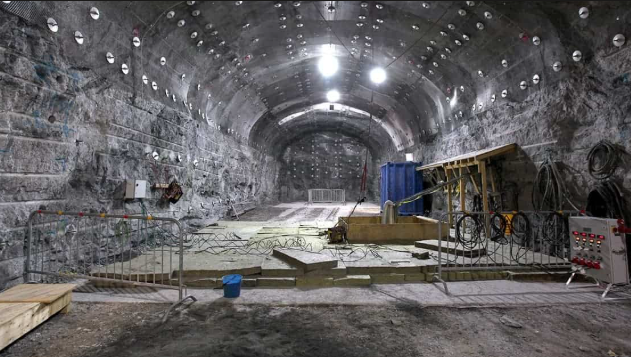
In Finland, work continues on the Onkalo spent nuclear fuel repository, a facility built into 1.9-billion-year-old bedrock that is set to become the world’s first operational permanent repository for high-level nuclear waste. The site, located on Finland’s west coast near the Olkiluoto nuclear power station, is designed to store spent fuel hundreds of metres underground in some of the most geologically stable rock on Earth. The surrounding crystalline bedrock has remained largely unchanged since the Paleoproterozoic era, making it an ideal natural barrier against groundwater flow and surface disturbances.
The disposal system combines engineered and geological protections to isolate radioactive material over extremely long timescales. Spent fuel assemblies are sealed in copper canisters with cast iron inserts, then embedded in bentonite clay, which swells to seal cracks and block water movement once underground. Scientists estimate the design lifespan of the barrier system at up to 100,000 years, far beyond recorded human history. Finland’s regulator has also required long-term safety modelling that accounts for future ice ages, seismic shifts, and even potential human intrusion scenarios. If fully commissioned as planned in the coming years, the facility would represent the first fully implemented deep geological repository in the world, setting a precedent for how countries manage nuclear waste that remains hazardous far beyond typical industrial timescales. More