
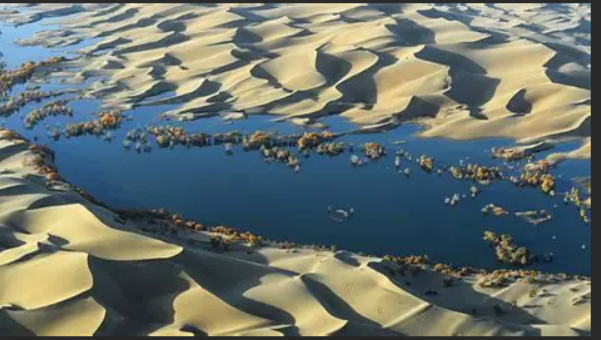
In one of the world’s most ambitious ecological restoration projects, China has been steadily transforming the edges of the Taklamakan Desert—the largest shifting sand desert in Asia—into a managed green buffer zone. Since the late 1970s, large-scale afforestation and sand-control programs have reportedly led to the planting of tens of billions of trees and shrubs across desert margins, forming what officials often describe as a “green belt” or “lung in the sand.” The goal is not to fully eliminate the desert, but to stabilize sand dunes, reduce dust storms, and protect nearby settlements and infrastructure, including key transport and energy corridors.
Some regional reports and studies suggest that vegetation cover in certain managed zones has increased noticeably, helping reduce wind erosion and improving local microclimates, with some areas experiencing more seasonal moisture retention and reduced desert expansion. However, scientists note that these effects are highly localized and depend on irrigation, groundwater availability, and long-term ecological balance. While the project is widely seen as a major example of large-scale ecological engineering, experts also caution that sustaining such massive green barriers in arid regions requires careful water management to avoid stressing already fragile desert ecosystems. More