
For centuries, international borders have been defended by armies, naval fleets, surveillance systems, and diplomatic agreements. Yet, one of the world’s most effective border guardians has remained largely invisible in political discourse. Mangrove forests occupying the fragile interface between land and sea stand as silent soldiers protecting coastlines, maritime boundaries, ecosystems, and millions of livelihoods. Unlike military defenses, they neither demand salaries nor political recognition. Instead, they absorb storms, stabilize shorelines, trap sediments, store vast amounts of carbon, nurture fisheries, and safeguard biodiversity. Ironically, while governments invest billions in border security and coastal infrastructure, these natural guardians continue to disappear at an alarming pace.
The question confronting policymakers, researchers, and coastal nations is no longer whether mangroves are valuable. The real question is whether humanity is deliberately allowing its most effective coastal defenders to die.
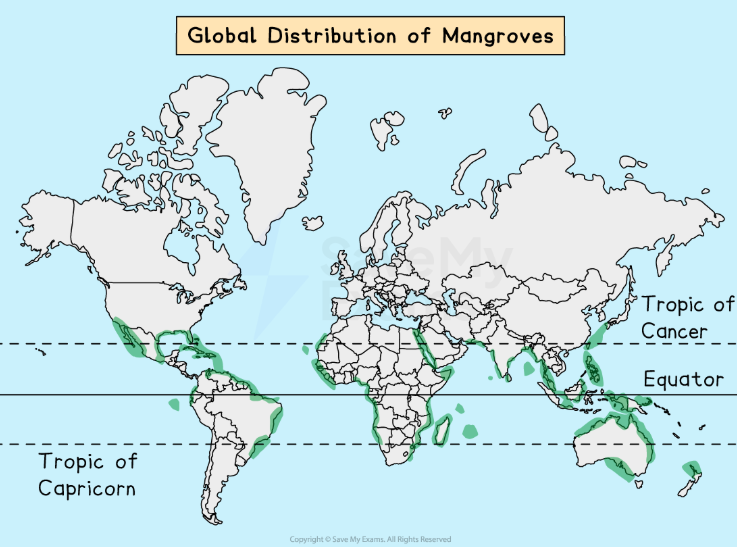
Mangroves occupy only about 147,000 square kilometers, representing less than 1% of tropical forests, yet their ecological significance is disproportionately large. According to the Global Mangrove Watch, mangroves exist across 118 countries and territories, with nearly 50% concentrated in just four countries Indonesia, Brazil, Australia, and Mexico. Indonesia alone hosts approximately 20-23% of the world’s mangrove forests, making its conservation policies globally significant.
Their strategic importance extends beyond ecology. Many mangrove ecosystems occur along politically sensitive coastlines, estuaries, and maritime boundaries. From the Sundarbans shared by India and Bangladesh to the mangrove-rich coasts of Southeast Asia, West Africa, the Caribbean, and northern Australia, these forests reinforce coastlines against erosion that could gradually alter territorial shorelines and affect maritime baselines under international law. As sea levels rise, stable coastlines increasingly become matters of geopolitical concern.
Mangroves perform ecosystem services valued at an estimated US$33,000 -57,000 per hectare annually, depending on the methodology used. Globally, they contribute well over US$150 billion every year through fisheries support, carbon storage, tourism, coastal protection, and disaster-risk reduction. Despite this immense economic value, governments continue to underestimate them in national accounting systems.
Perhaps their greatest contribution lies beneath the soil. Mangroves are among Earth’s most efficient blue carbon ecosystems, storing up to four to five times more carbon per hectare than many tropical terrestrial forests, with most carbon locked deep within waterlogged sediments for centuries. When mangroves are cleared, this stored carbon is released into the atmosphere, transforming long-term carbon sinks into significant greenhouse gas sources. Conserving mangroves therefore represents one of the most cost-effective natural climate solutions available today.
Their defensive role became globally recognized following the 2004 Indian Ocean tsunami. Numerous scientific studies found that coastal villages protected by intact mangrove belts experienced lower wave energy, reduced property damage, and fewer fatalities than neighboring areas where mangroves had been removed. Similar evidence has emerged after cyclones in Bangladesh, hurricanes in the Caribbean, and typhoons across Southeast Asia. In an era where climate-driven disasters are increasing in both frequency and intensity, mangroves function as living coastal fortifications.
Yet these silent soldiers are steadily retreating.
Historically, the world has lost approximately 35 -50% of its mangrove forests over the past five decades, although the rate of loss has slowed in some regions due to improved conservation. The principal drivers remain remarkably consistent across countries: shrimp aquaculture, coastal urbanization, tourism infrastructure, industrial ports, agricultural expansion, pollution, and unsustainable logging. Climate change has added new threats through accelerated sea-level rise, altered salinity, prolonged droughts, stronger cyclones, and marine heatwaves.
The contradiction is striking. Governments publicly celebrate climate commitments while simultaneously approving coastal developments that fragment or destroy mangrove ecosystems. Environmental impact assessments frequently underestimate the cumulative consequences of incremental mangrove loss. Restoration projects, while politically attractive, often receive greater publicity than the destruction they attempt to compensate. Planting thousands of seedlings cannot substitute for protecting centuries-old functioning ecosystems.
This contradiction is particularly visible across many mangrove-rich nations.
Indonesia has significantly expanded restoration through its National Mangrove Rehabilitation Program while continuing to balance competing demands from aquaculture, mining, and infrastructure development. India has increased mangrove cover in several regions through conservation efforts, yet industrial expansion and urban pressures continue to threaten coastal ecosystems in states such as Gujarat and Maharashtra. Bangladesh has strengthened community-based protection in the Sundarbans but faces rising pressures from climate change and upstream hydrological alterations. Brazil possesses some of the world’s largest mangrove systems, although port expansion and coastal development continue to generate environmental concerns. Australia generally maintains stronger regulatory frameworks, yet localized losses from coastal development and extreme climatic events remain evident.
The challenge is therefore not limited to developing nations. Wealthier countries often possess greater financial capacity but continue to prioritize short-term economic gains over long-term ecological security. Meanwhile, lower-income countries frequently struggle to reconcile development needs with conservation despite relying more directly on ecosystem services.
The international community has also been inconsistent. Mangroves receive recognition under the Ramsar Convention, contribute directly to the Convention on Biological Diversity, support the Paris Agreement, and advance several Sustainable Development Goals, including SDGs 13, 14, and 15. However, implementation remains fragmented. Conservation financing remains insufficient compared with investments in engineered coastal defenses. Nationally Determined Contributions (NDCs) frequently acknowledge blue carbon ecosystems without establishing robust monitoring, enforcement, or restoration targets backed by sustained funding.
A more critical question must therefore be asked: Are governments treating mangroves as strategic national infrastructure or merely as environmental assets?
If highways, ports, airports, and naval installations receive dedicated maintenance budgets because they protect national interests, then mangroves deserve similar recognition. They reduce disaster recovery costs, strengthen food security, support fisheries that employ millions, preserve biodiversity, secure carbon stocks, and reinforce coastlines that define national territory. Few infrastructure investments deliver such diverse returns while requiring comparatively modest public expenditure.
Future coastal security will not depend solely on artificial seawalls or military surveillance. It will depend equally on healthy ecosystems capable of adapting naturally to changing climates. Research increasingly demonstrates that hybrid solutions combining engineered defenses with intact mangrove ecosystems often outperform purely engineered alternatives while delivering additional environmental and economic benefits.
The world’s mangroves have defended humanity for thousands of years without recognition, medals, or political speeches. They have absorbed storms, stabilized borders, protected communities, and sustained coastal civilizations. Today, however, these silent soldiers face an enemy they cannot repel alone: human short-sightedness.
The question confronting every mangrove-bearing nation from Indonesia to Brazil, Australia to Nigeria, India to Mexico, Bangladesh to the United States is not whether restoration campaigns make impressive headlines. It is whether national policies genuinely prioritize the protection of existing mangrove ecosystems before they disappear.
History may ultimately judge countries not by the length of their coastlines or the strength of their naval forces, but by whether they preserved the living barriers that nature had already built for them. For if these silent soldiers continue to fall, humanity will inherit coastlines that are more vulnerable, economies that are more fragile, and borders that are increasingly exposed to the combined forces of climate change and ecological collapse.
Bibliography:
Green and gray: Mangroves and dikes show potential in protecting shorelines together