
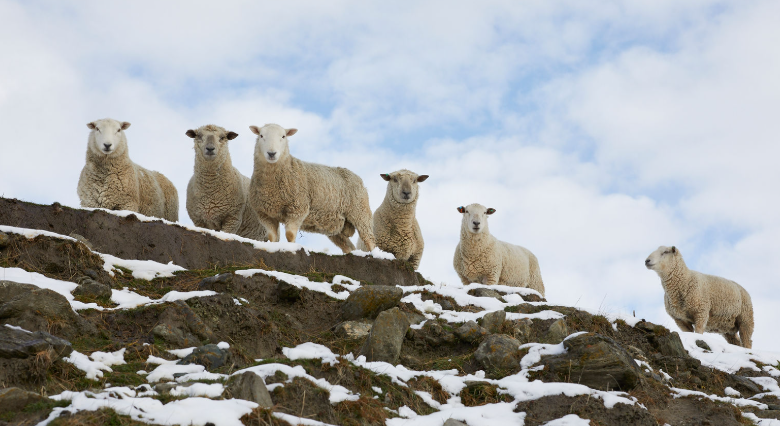
Could an overlooked natural material help protect Switzerland’s shrinking glaciers? Scientists are putting sheep’s wool to the test on the Tsanfleuron Glacier at Glacier 3000 in western Switzerland. The experiment, known as “Keep It Wool,” uses two wool blankets covering about 200 square metres of glacier surface as a biodegradable alternative to the synthetic geotextiles traditionally used during summer. These covers work by reflecting sunlight and reducing the amount of solar energy absorbed by snow and ice. Measurements taken every two weeks through the summer showed that the wool blankets were as effective as conventional synthetic covers at slowing melting, with the thicker wool prototype performing slightly better. The experiment is also addressing another environmental problem: an estimated 40–70% of Swiss sheep’s wool is discarded each year, often being composted or burned.
The idea has scientific potential, but researchers are clear that wool cannot stop glacier loss on a large scale. Switzerland’s glaciers are losing ice because rising air temperatures increase surface melting and reduce the amount of snow that survives each summer. Wool can provide local, short-term protection, but only around 0.02% of Switzerland’s glacier area is currently covered by protective materials. That makes the experiment more of a climate-adaptation measure than a solution to global warming. Still, turning an underused agricultural material into a biodegradable protective layer could reduce dependence on plastic-based covers and prevent microfibre pollution. The experiment offers an interesting lesson in sustainability: sometimes innovation is not about inventing something completely new, but finding a smarter use for something we already have. More