
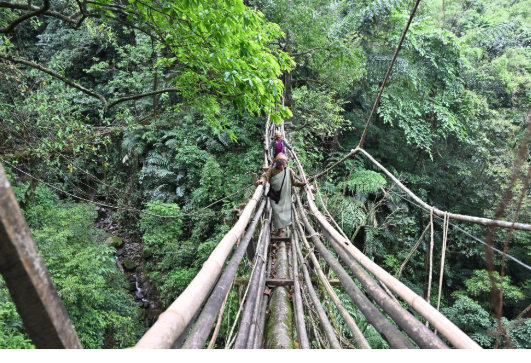
In the rain-soaked hills of Meghalaya, one of the wettest places on Earth, Indigenous communities have developed a remarkable way to live with nature rather than against it. The Khasi and Jaintia people grow “living root bridges” by guiding the aerial roots of rubber fig trees across rivers and valleys. Over time—often 15 to 30 years—these roots strengthen and fuse, forming natural bridges that can last for hundreds of years and support the weight of dozens of people. Unlike steel or wooden structures, these bridges become stronger with age and require no industrial materials.
These bioengineered structures are perfectly adapted to the region’s extreme climate, where annual rainfall can exceed 11,000 mm, especially in areas like Cherrapunji and Mawsynram. The living bridges resist floods, landslides, and decay far better than conventional infrastructure, making them both resilient and sustainable. In addition to bridges, communities also create ladders and pathways from roots to navigate steep terrain. Scientists and architects increasingly study these systems as examples of long-term, low-carbon design, showing how traditional knowledge can offer solutions for modern climate challenges. More